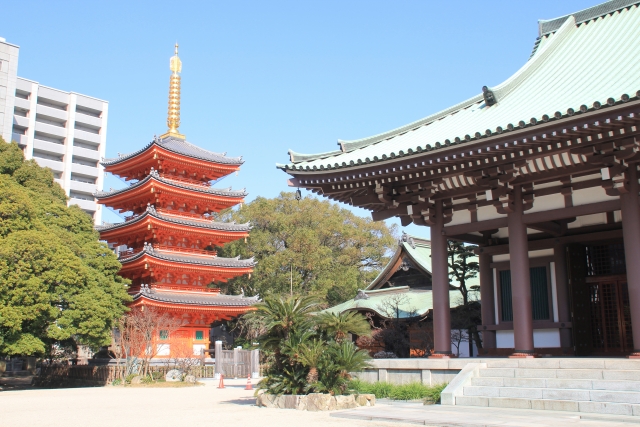
Tōchō-ji (temple)
Tōchō-ji is a Shingon Buddhist temple located in Hakata Ward, Fukuoka City, Fukuoka Prefecture. Known as a significant center for the Shingon sect in Kyushu, it is one of the historical temples in Fukuoka’s old town.
History
The temple was founded in 806 by Kūkai (Kōbō Daishi) upon his return from studying Buddhism in China. During his stay in Hakata, he carved a statue of Fudō Myōō (Acala) as the main deity and established the temple, naming it Tōchō Mitsu-ji (“Temple of the Long-lasting Transmission of Esoteric Buddhism to the East”). It is considered one of Japan’s oldest temples founded by Kūkai.
Originally located near Hakata’s coastline, the temple flourished with large structures, but it suffered destruction during various wars. It was rebuilt multiple times, and during the Edo period, the Kuroda clan, lords of Fukuoka, contributed significantly to its restoration. They provided land and resources, making it a prominent Buddhist site.
Today, Tōchō-ji remains an important historical and cultural landmark in Fukuoka, attracting visitors with its rich heritage and religious significance.
The Great Buddha Hall (Daibutsuden) at Tōchō-ji houses the Fukuoka Daibutsu, a massive wooden seated statue of Vairocana Buddha (Dainichi Nyorai). Completed in 1992, the statue is one of the largest wooden seated Buddhas in Japan, standing 10.8 meters tall, with a halo reaching 16.1 meters and weighing 30 tons. The height symbolizes the 108 worldly desires in Buddhism.
The statue is made of Japanese cypress and features the Hokkai Jōin (Cosmic Mudra) hand gesture. Behind the Buddha, the wall displays 5,000 smaller Buddha statues. Surrounding the base is a dark passageway for visitors to experience the “Journey through Hell and Paradise” (Jigoku-Gokuraku Meguri).
The hall itself is a two-story reinforced concrete structure, with the Buddha located on the second floor and a parking area on the first.
The Five-Story Pagoda at Tōchō-ji, completed in May 2011, is a 25.9-meter-tall structure crafted entirely from Japanese cypress using traditional construction methods without nails. It houses a statue of Vairocana Buddha (Dainichi Nyorai) as its principal deity.
Features:
- Materials: Made from high-quality Yoshino and Shimanto cypress (78 tons of wood in total).
- Roof: Features 17,850 frost-resistant Mino tiles from Gifu.
- Spire: An 8-meter bronze spire with gold leaf finish, adorned with emblems of the Kuroda family and the temple. Modern earthquake-resistant technology, including seismic rubber, enhances its stability.
- Base: Constructed with granite from Okayama (pedestals) and Saga (foundation stones), weighing 30 tons in total.
- Interior: Although not open to the public, it is decorated with traditional Japanese paintings depicting seasonal scenes and Buddhist imagery.
- Protection: Painted with natural materials like animal glue, red lead, and gofun (shell powder) for preservation.
The pagoda is a stunning blend of traditional craftsmanship and modern engineering.
A Five-Story Pagoda (Gojū-no-tō) is a traditional Japanese architectural structure often found in Buddhist temples. It represents the five elements of Buddhist cosmology: earth, water, fire, wind, and void. The pagoda serves as a sacred structure, symbolizing enlightenment and spiritual ascension.
Key Features:
- Structure: Five tiers stacked vertically, each diminishing in size as they ascend, symbolizing the journey toward enlightenment.
- Materials: Typically made of wood or stone, constructed using traditional techniques such as interlocking beams and no nails.
- Interior: Usually empty or contains sacred relics, statues, or decorations.
- Symbolism: The central pillar, or shinbashira, represents the axis of the universe, providing stability and symbolic connection between heaven and earth.
- Design: Pagodas often include intricate carvings, vibrant colors, and curved roofs with ornaments like sōrin (finials) at the top, which may have symbolic or practical purposes.
Pagodas are admired not only for their spiritual significance but also for their architectural beauty, blending harmony with nature and resilience against earthquakes.

これも好きかも